How to Extend Hybrid Car Battery Life: A Mechanic’s Guide
The most reliable way to extend the life of a hybrid car battery is to protect it from heat, keep it cycling regularly, and catch degradation early through professional diagnostics. Hybrid batteries typically last 10 to 15 years or up to 200,000 km with proper care, but neglect the right maintenance steps, and you could be facing a replacement bill of $2,000 to $8,000 long before that milestone. This guide covers the daily habits, seasonal maintenance checks, and warning signs every hybrid owner in Canada needs to know.
How Long Should a Hybrid Car Battery Last?
A healthy hybrid battery is built to outlast most major engine components. Under Canadian federal standards, which mirror US requirements, automakers must warrant hybrid batteries for a minimum of 8 years or 160,000 km. Toyota goes further, offering a 10-year/240,000 km warranty on select models, and Kia backs its hybrid batteries until the battery pack’s capacity drops below 70% of its original.
In practice, well-maintained hybrid batteries routinely exceed 200,000 km. The catch is that they do not fail suddenly. They degrade gradually, and most owners do not notice anything is wrong until fuel economy has already slipped by 10 to 15%, at which point the battery has been underperforming for months.
Ontario drivers face a specific challenge here. The combination of 20-below-zero winters and 35-degree summer parking lots, layered with stop-and-go traffic on the 401 and Hurontario, puts more thermal stress on a hybrid battery pack than owners in milder climates typically experience. That makes proactive maintenance, not just avoiding bad habits, essential.
What Actually Kills a Hybrid Battery
Most articles on this topic hand you a list of tips without explaining why any of it matters. Here is what actually shortens battery life, based on what mechanics see on the lift:
Heat accumulation is the single biggest killer. Hybrid battery packs rely on a dedicated cooling system, either a fan drawing cabin air through the pack or a separate liquid-cooling loop, to stay within safe operating temperatures. When that system is blocked or neglected, heat builds up inside the pack, accelerating the chemical degradation of individual cells. A battery running even 5 to 10 degrees Celsius hotter than designed can lose months of service life per year.
Deep discharge cycles hit plug-in hybrid (PHEV) owners hardest. Repeatedly draining the battery below 20% state of charge stresses the internal chemistry. Traditional self-charging hybrids like the Prius manage this automatically because the car’s battery management system keeps the pack in a safe mid-range. Still, PHEV owners’ charging habits directly affect how quickly the battery wears out.
Extended inactivity causes a cell voltage imbalance. When a hybrid sits unused for weeks, individual cells within the pack drift to different charge levels. When the car is started again, the management system has to work harder to equalize them, which shortens overall pack life over time.
Frequent, very short trips under 5 km prevent the battery from reaching its optimal operating temperature. The gas engine ends up compensating more than it should, increasing wear on both the engine and the battery.
Finally, a weak 12-volt auxiliary battery places extra load on the hybrid system. Most hybrid owners do not know that the small conventional battery, the one that runs the electronics and starts the system, is directly linked to hybrid battery health. When the 12V battery degrades, it can trigger false warnings in the hybrid system and force extra charge cycles. Find out more about car battery service at Tabangi to keep both batteries on schedule.
7 Daily Habits That Extend Hybrid Battery Life
None of these requires tools or a shop visit. There are changes to how you drive and park that compound over the years, resulting in real gains in battery life.
- Drive at least 3 to 4 times per week. Regular use keeps the battery cells active and cycling normally. A hybrid sitting idle for more than a week starts to develop a voltage imbalance between cells. A short 15-minute drive is enough to maintain a healthy cycling habit.
- Accelerate and brake smoothly. Hard acceleration draws a large current burst from the battery, generating excess heat. Gradual acceleration spreads the load. Smooth braking lets the regenerative system capture kinetic energy and convert it back into charge, a free top-up that costs nothing.
- Coast whenever traffic allows. Anticipating slowdowns and coasting instead of braking hard maximizes regenerative braking and reduces thermal stress on the battery. In stop-and-go conditions on Mississauga roads, this habit alone can meaningfully reduce the intensity of battery cycling.
- Keep the PHEV charge between 20 and 80%. Traditional hybrids manage this automatically. If you drive a plug-in hybrid, avoid habitually charging to 100% overnight and then leaving the vehicle fully charged for hours. Lithium-ion cells degrade faster when held at full charge for extended periods.
- Park in a garage or shaded spot. A car parked in direct Ontario summer sun can see cabin temperatures exceed 60 degrees Celsius, and battery pack temperatures follow. Parking in shade or a garage is one of the simplest ways to reduce thermal stress.
- Keep the rear cabin area clear. Toyota, Lexus, and many other hybrids draw cooling air for the battery pack directly through the rear cabin. A loaded cargo area, a rear-mounted pet crate, or piled-up winter gear can block airflow to the battery’s cooling vents. This is one of the most overlooked causes of premature battery degradation.
- Use Level 1 or Level 2 charging at home (PHEVs). Level 3 DC fast charging generates significantly more heat during charging and imposes higher voltage stress on cells. It is useful in emergencies or on road trips, but using it as your daily charging method shortens battery life. Slow overnight charging through a standard Level 2 home charger is far gentler on the pack.
The Maintenance Schedule That Protects Your Hybrid Battery
Daily habits address what happens between service visits. But some of the most important protective measures require proper equipment, the kind a qualified auto repair shop has on hand. Here is what should happen at each maintenance interval for a hybrid vehicle:
Every 5,000 km, or with every oil change
- Hybrid system OBD2 scan: hybrid fault codes do not always immediately trigger a warning light. A quick scan during every oil change catches soft faults before they become hard failures.
- 12-volt battery voltage test: takes 90 seconds and flags an auxiliary battery that is starting to fade before it strands you or stresses the hybrid system.
- Visual inspection of battery cooling vents: debris, dirt, and pet hair accumulate at the battery cooling fan’s intake and exhaust vents. A technician can clear blockages before they cause heat buildup.
Every 20,000 km, or annually
- Cabin air filter replacement: on Toyota, Lexus, and many other hybrids, the battery cooling system draws air through the same path as the cabin air filter. A clogged cabin filter restricts airflow to the battery pack, raising operating temperatures. Most owners have no idea these are connected. See Tabangi’s air filter replacement service for scheduling.
- Battery cooling fan function test: the fan itself can fail or degrade without any immediate warning light. A technician tests the operation speed and noise. A whining or inconsistent fan is a sign that the motor is wearing out.
- Inverter coolant level check: plug-in hybrids and many standard hybrids have a separate coolant loop for the power inverter, a component distinct from the engine cooling system. This fluid is rarely discussed in owners’ manuals, but it degrades over time and needs inspection.
Every 40,000 to 60,000 km
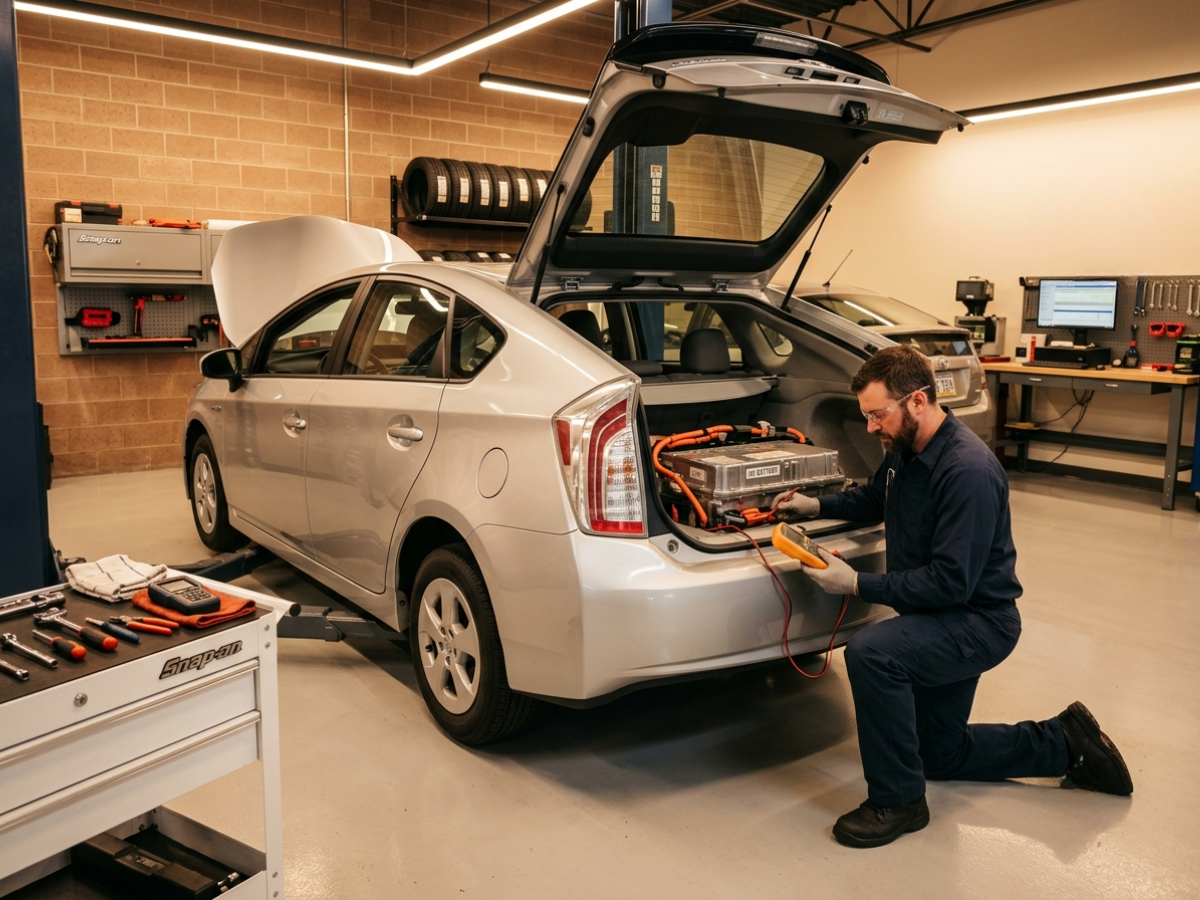
- Battery capacity diagnostic: not a warning-light check, but an actual capacity test measuring how much charge the pack can hold versus its original design specification. Early-stage degradation shows up here months before fuel economy noticeably drops.
- Software and firmware updates: manufacturers regularly release battery management system (BMS) updates that refine how the car charges and discharges the pack. These updates are applied during service visits and can meaningfully extend battery life. Most owners never know they exist unless a technician checks.
If you are unsure when your hybrid last had any of these checks done, Tabangi’s NAPA AUTOPRO certified technicians can run a full hybrid health inspection and confirm what is due. Book through the general maintenance page or call (905) 670-8100.
Warning Signs Your Hybrid Battery Is Degrading
The earlier you catch battery degradation, the more options you have. A cell reconditioning or module swap at an early stage can cost $300 to $800. Waiting until the pack needs full replacement pushes that figure to $2,000 to $8,000, depending on the vehicle make and whether you go OEM or refurbished. Natural Resources Canada’s fuel consumption guide is a useful baseline for tracking your hybrid’s expected efficiency. A meaningful drop from those benchmarks is often the first measurable sign of battery degradation.
Watch for these signals:
- Declining fuel economy: the most reliable early indicator. If your Prius or Camry hybrid is suddenly burning noticeably more fuel than usual, the battery is likely not assisting the engine as effectively as it should. Track your fill-up numbers.
- Gas engine running more at low speeds: a healthy hybrid runs on electric power alone during slow city driving. If you notice the engine firing up more frequently in stop-and-go traffic, the battery may not be holding enough charge to carry the load.
- Rapid charge gauge swings: a battery gauge that drops quickly from full to low, or swings back and forth unpredictably, suggests individual cells within the pack are developing uneven capacity.
- Unusually loud or constant cooling fan: the battery pack’s cooling fan runs harder when the pack is running hot. A fan that is louder than usual or runs constantly even after parking is a sign that the battery is under thermal stress.
- “Check Hybrid System” warning light: this is not the same as a check engine light. A hybrid system warning requires diagnosis at a shop with the right scan tools. Do not ignore it or wait for it to disappear. It rarely does on its own.
- Reduced electric-only range (PHEVs): if your PHEV used to offer 40 km of electric range and now delivers only 28 km, the battery has measurably degraded. This is worth a capacity test before the drop gets steeper.
When to Handle It Yourself vs. Call a Mechanic
The habits outlined above, parking in shade, smooth driving, keeping rear seats clear, and managing charge levels, are entirely within the driver’s control and cost nothing. They address the main causes of premature degradation before any damage is done.
What they cannot do is tell you how much capacity your battery has actually lost, whether your cooling fan is operating at the right speed, or whether a firmware update is available for your battery management system. That requires diagnostic equipment. A scan tool capable of reading hybrid-specific codes, a battery capacity tester, and the manufacturer’s technical service bulletins are all found at a properly equipped auto repair shop, not in the owner’s manual.
The practical rule: build the daily habits now, and pair them with a scheduled hybrid health check every 20,000 km. That combination addresses both controllable wear factors and hidden degradation that only diagnostics can detect.
Frequently Asked Questions
How often should I have my hybrid battery inspected?
A basic check, including an OBD2 scan and a cooling vent inspection, should be performed at every oil change interval, roughly every 5,000 km. A full capacity diagnostic is worth doing every 40,000 to 60,000 km, or sooner if you notice a drop in fuel economy or any hybrid system warning lights on your dashboard.
Does cold weather permanently damage a hybrid battery?
Cold temperatures reduce a hybrid battery’s power output temporarily but do not cause lasting damage the way heat does. In very cold conditions, the pack delivers less electric assist, and fuel economy drops noticeably. This reverses once the battery warms up. Persistent heat above operating temperature, on the other hand, causes irreversible chemical degradation to the cells.
Can I replace just one bad cell in a hybrid battery pack?
In some cases, yes, particularly for older nickel-metal hydride (NiMH) packs. A qualified technician can identify weak modules within the pack and replace only those cells, which can cost significantly less than a full pack replacement. Lithium-ion packs in newer hybrids are more complex to recondition. A capacity diagnostic determines whether module replacement is viable or a full pack offers better value.
Does aggressive highway driving harm the hybrid battery more than city driving?
No. Steady highway speeds are relatively easy on a hybrid battery. The gas engine carries most of the load at higher speeds, so the battery cycles less intensively. Stop-and-go city driving cycles the battery more frequently, but this is what hybrids are designed for. The most damaging driving pattern is repeated hard acceleration from a stop, which draws large current bursts and generates excess heat.
How much does hybrid battery replacement cost in Canada?
Hybrid battery replacement in Canada typically ranges from $2,000 to $8,000, depending on the vehicle make and model, and whether you choose an OEM pack, a certified refurbished unit, or a reconditioned unit. Toyota and Honda OEM packs sit toward the higher end, while refurbished packs for older Prius models are available for less, usually with a limited warranty through the supplier.
Is it worth reconditioning a hybrid battery instead of replacing it?
Reconditioning, which cycles the battery through controlled charge and discharge to rebalance cells, can restore partial capacity in a mildly degraded NiMH pack and may cost only $300 to $600. It is worth exploring before committing to a full replacement. A capacity test first tells you how much degradation has occurred and whether reconditioning is likely to recover a meaningful range, or whether a replacement makes more economic sense.
Keep Your Hybrid Battery Healthy Year-Round
The fundamentals are straightforward: protect the battery from heat, drive it regularly, manage charge levels, and stay on top of maintenance items that require a shop visit. For Ontario hybrid owners, adding a seasonal lens, clearing cooling vents before summer and confirming the 12V battery is strong before winter, closes the gap that our climate opens up compared to milder regions.
If your hybrid has not had a battery health check in the last year, or if you have noticed any drop in fuel economy, the NAPA AUTOPRO certified technicians at Tabangi Service Centre in Mississauga can run a full hybrid system diagnostic covering the cooling fan, 12V battery, OBD2 fault codes, and capacity test. Most checks are completed same-day. Book an appointment online or call (905) 670-8100.